🌍 Global Climate Solutions
Exploring the intersection of technology, economics, and environmental stewardship.
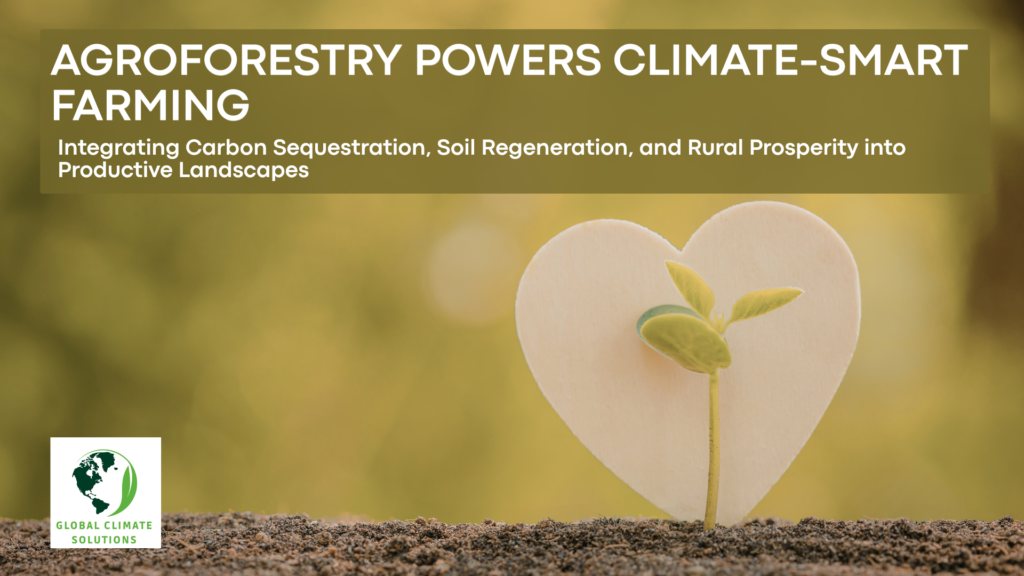
This week, we examine how agroforestry integrates trees into farming systems to strengthen soil health, biodiversity, and climate resilience—while improving rural livelihoods.
🌳🌾 Agroforestry as a Climate-Smart Land Management Strategy
Agroforestry combines agriculture and forestry to optimize land use across environmental and economic dimensions. By integrating trees into crop and livestock systems, farmers create multifunctional landscapes that improve productivity while enhancing ecological resilience.
Silvopastoral systems integrate trees with grazing livestock, providing shade, shelter, and improved soil structure. Silvoarable systems combine trees with arable crops, supporting nutrient cycling and microclimate regulation. These systems are adaptable across regions and climates, making agroforestry a scalable solution for sustainable agriculture.
🌱 Soil Health and Ecosystem Benefits
Tree roots stabilize soils, reduce erosion, and increase organic matter content. Nitrogen-fixing species naturally enrich soils, lowering reliance on synthetic fertilizers and reducing agricultural runoff. Over time, these improvements enhance productivity while decreasing input costs.
Agroforestry also strengthens biodiversity. Diverse vegetation layers provide habitats for pollinators, birds, and beneficial insects, supporting natural pest regulation and reducing chemical dependency. By fostering ecological balance, agroforestry reinforces long-term agricultural sustainability.
🌍 Climate Mitigation and Adaptation
Trees embedded within agricultural landscapes act as carbon sinks, capturing and storing atmospheric carbon dioxide. At the same time, they moderate local temperatures, reduce wind exposure, and increase water retention capacity in soils.
These functions enhance resilience against droughts, extreme heat, and shifting rainfall patterns—making agroforestry both a mitigation and adaptation strategy in the face of climate change.
💼 Economic and Rural Development Advantages
Agroforestry diversifies farm outputs through timber, fruits, nuts, and other tree-based products. This diversification strengthens rural incomes and reduces vulnerability to crop failures or market fluctuations.
By aligning environmental performance with economic opportunity, agroforestry supports community development and long-term food security while improving landscape sustainability.
🔆 Case Study: Scotland’s Forestry Grants Scheme
Scotland’s Forestry Grant Scheme, updated in October 2024 and delivered by Scottish Forestry, promotes agroforestry through financial support for silvopastoral and silvoarable systems across grazing and arable land. Farmers can choose planting densities of 150–200 or 300–400 trees per hectare, allowing flexibility to integrate trees into productive landscapes.
The grants advance timber production, biodiversity enhancement, and business diversification through fruit and nut trees, while ownership and maintenance requirements ensure long-term sustainability. The scheme highlights how targeted public funding can accelerate agroforestry adoption and strengthen climate resilience within national land management strategies.
📖 Read More
Read the full article by Robert C. Brears to explore how agroforestry systems strengthen soil health, enhance biodiversity, and provide scalable climate resilience solutions for agricultural landscapes.
Key Takeaways
Agroforestry integrates trees into agricultural systems to improve soil health, enhance biodiversity, sequester carbon, and diversify rural incomes. Policy instruments such as Scotland’s Forestry Grant Scheme show how structured funding can support the transition toward resilient and sustainable land management.
Circular Economy and Liveable Cities (Cambridge University Press)
The Circular Economy and Liveable Cities, edited by Robert C. Brears, Our Future Water, has been published. This essential guide delivers actionable strategies and best practices for implementing circular economy, climate resilience, and sustainability in urban environments, with global examples from leading cities like Tokyo, New York, and Singapore to help planners, policymakers, and researchers build liveable and sustainable cities for the future.
2nd Edition of Nature-Based Solutions to 21st Century Challenges (Routledge)
Fully revised and updated, the second edition of Nature-Based Solutions to 21st Century Challenges by Robert C. Brears offers a timely and systematic review of how working with nature can address today’s most pressing environmental and societal issues. Featuring new case studies from across the globe, expanded insights on public policy, AI, and community-led initiatives, this edition is essential reading for anyone shaping a sustainable future.
📚 Shape the Future of Sustainability: Contribute to Springer Nature’s Landmark Publications
As Editor-in-Chief, Robert C. Brears invites experts, researchers, and practitioners to contribute to impactful and forward-thinking publications from Springer Nature. These comprehensive Handbooks and Encyclopedias explore Nature-Based Solutions, sustainable resource management, ecosystem well-being, and the global energy transition.
- Palgrave Handbook of Nature-Based Solutions
- Palgrave Encyclopedia of Sustainable Resources and Ecosystem Resilience
- Palgrave Handbook of Ecosystems and Human Well-Being
- Palgrave Handbook of Energy Transition and Renewable Energy
- Palgrave Handbook of Urban Climate and Disaster Resilience
- Palgrave Handbook of Social Transformations in Science, Innovation, and Education
📚 Shape the Future of Climate Resilience: Contribute to Palgrave’s Pivot Series
As Series Editor, Robert C. Brears invites experts to contribute to Palgrave Studies in Climate Resilient Societies, a leading Pivot series (25,000–50,000 words) exploring climate resilience, policy innovation, and sustainability strategies.
📩 For more details, visit: Seeking Authors — Palgrave Studies in Climate Resilient Societies
📚 Explore the Full Book Collection on Green Economy & Innovation Pathways
Accelerate the shift to a low-carbon, inclusive future with expert insights from Our Future Water and Global Climate Solutions. This collection highlights the tools, technologies, and strategies driving resilient and sustainable economic transformation.
⚡ Policy frameworks for enabling sustainable, equitable growth
🔬 Innovations in clean technologies and future-focused business models
📘 Pathways for long-term systems change, resilience, and impact
Click here to explore the complete collection.