🌍 Global Climate Solutions
Exploring the intersection of technology, economics, and environmental stewardship.
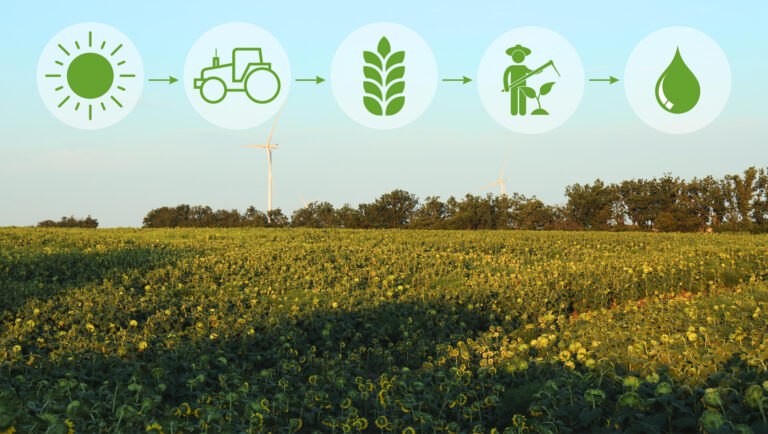
This week, we examine how climate-smart agriculture (CSA) strengthens food systems by increasing productivity, building resilience to climate shocks, and delivering lower emissions and stronger soil and water security.
🌱 Climate-Smart Agriculture as an Integrated Farming Framework
CSA is an integrated farming framework designed to simultaneously increase agricultural productivity, enhance resilience to climate change, and reduce greenhouse gas emissions. It aligns crop, soil, water, and livestock management within a systems-based approach that safeguards livelihoods while conserving natural resources.
By addressing soil degradation, water scarcity, and shifting weather patterns together, CSA supports stable yields, lowers input waste, and strengthens long-term food and environmental security.
⚙️ Resource Efficiency and Climate-Responsive Production
At the core of CSA is precision resource management. Technologies that optimize irrigation and fertilizer application reduce input waste, while crop diversification and the adoption of drought- and heat-tolerant varieties help farms adjust to changing climate conditions.
These measures stabilize yields under extreme weather, reduce production costs, and limit nitrous oxide and other emissions linked to excessive fertilizer use. The result is higher productivity with lower environmental impact and reduced climate risk exposure.
🌾 Soil Health and Carbon Sequestration
CSA prioritizes soil as a productive and climate-regulating asset. Practices such as minimum tillage, cover cropping, and crop rotation improve soil structure, increase organic matter, and reduce erosion.
Healthier soils retain more water, store more carbon, and require fewer synthetic inputs. This enhances yield stability, strengthens drought resilience, and contributes to emissions mitigation through carbon sequestration.
💧 Water Stewardship and Livestock Integration
Efficient water management is central to climate resilience. Drip irrigation, rainwater harvesting, and water recycling reduce dependence on groundwater and improve water-use efficiency, particularly in drought-prone regions.
Integrated livestock systems further close nutrient loops. Improved feeding, animal health management, and manure handling reduce methane and nitrous oxide emissions, while recycling crop residues and manure enhances soil fertility and farm productivity.
🔆 Case Study: Australia’s Climate-Smart Agriculture Program — Scaling Resilient Farming
The Australian Government’s $302.1 million Climate-Smart Agriculture Program, delivered under the Natural Heritage Trust, supports farmers and land managers to adopt practices that reduce emissions, enhance resilience, and protect natural resources. The program translates CSA principles into coordinated national and regional action.
Funding streams include $45 million for Partnerships and Innovation Grants to develop and deploy sustainable farming tools, $15 million for Capacity Building Grants to strengthen knowledge and skills, and $13 million in Small Grants for community-led initiatives. A further $21.6 million supports the National Soil Monitoring Program, alongside $6 million to strengthen the Australian National Soil Information System.
More than $161 million funds Regional Delivery Partners and National Landcare Organizations, ensuring region-specific solutions and localized advisory support. Together, these instruments link innovation, soil data, community action, and regional governance to improve productivity, resilience, and land stewardship at scale.
📖 Read More
Read the full article by Robert C. Brears to explore how CSA integrates technology, soil and water stewardship, and policy support to strengthen food security. The article demonstrates how targeted investment and partnerships can simultaneously enhance productivity, resilience, and emissions reduction.
Key Takeaways
CSA integrates precision resource use, soil carbon management, water stewardship, climate-adaptive crops, and livestock systems into a unified framework that boosts productivity while reducing emissions and strengthening resilience. Structured policy support, targeted public investment, and multi-level partnerships are essential to scaling these practices and building low-carbon, resource-secure food systems.
Circular Economy and Liveable Cities (Cambridge University Press)
The Circular Economy and Liveable Cities, edited by Robert C. Brears, Our Future Water, has been published. This essential guide delivers actionable strategies and best practices for implementing circular economy, climate resilience, and sustainability in urban environments, with global examples from leading cities like Tokyo, New York, and Singapore to help planners, policymakers, and researchers build liveable and sustainable cities for the future.
2nd Edition of Nature-Based Solutions to 21st Century Challenges (Routledge)
Fully revised and updated, the second edition of Nature-Based Solutions to 21st Century Challenges by Robert C. Brears offers a timely and systematic review of how working with nature can address today’s most pressing environmental and societal issues. Featuring new case studies from across the globe, expanded insights on public policy, AI, and community-led initiatives, this edition is essential reading for anyone shaping a sustainable future.
📚 Shape the Future of Sustainability: Contribute to Springer Nature’s Landmark Publications
As Editor-in-Chief, Robert C. Brears invites experts, researchers, and practitioners to contribute to impactful and forward-thinking publications from Springer Nature. These comprehensive Handbooks and Encyclopedias explore Nature-Based Solutions, sustainable resource management, ecosystem well-being, and the global energy transition.
- Palgrave Handbook of Nature-Based Solutions
- Palgrave Encyclopedia of Sustainable Resources and Ecosystem Resilience
- Palgrave Handbook of Ecosystems and Human Well-Being
- Palgrave Handbook of Energy Transition and Renewable Energy
- Palgrave Handbook of Urban Climate and Disaster Resilience
- Palgrave Handbook of Social Transformations in Science, Innovation, and Education
📚 Shape the Future of Climate Resilience: Contribute to Palgrave’s Pivot Series
As Series Editor, Robert C. Brears invites experts to contribute to Palgrave Studies in Climate Resilient Societies, a leading Pivot series (25,000–50,000 words) exploring climate resilience, policy innovation, and sustainability strategies.
📩 For more details, visit: Seeking Authors — Palgrave Studies in Climate Resilient Societies
📚 Explore the Full Book Collection on Green Economy & Innovation Pathways
Accelerate the shift to a low-carbon, inclusive future with expert insights from Our Future Water and Global Climate Solutions. This collection highlights the tools, technologies, and strategies driving resilient and sustainable economic transformation.
⚡ Policy frameworks for enabling sustainable, equitable growth
🔬 Innovations in clean technologies and future-focused business models
📘 Pathways for long-term systems change, resilience, and impact