🌍 Global Climate Solutions
Exploring the intersection of technology, economics, and environmental stewardship.
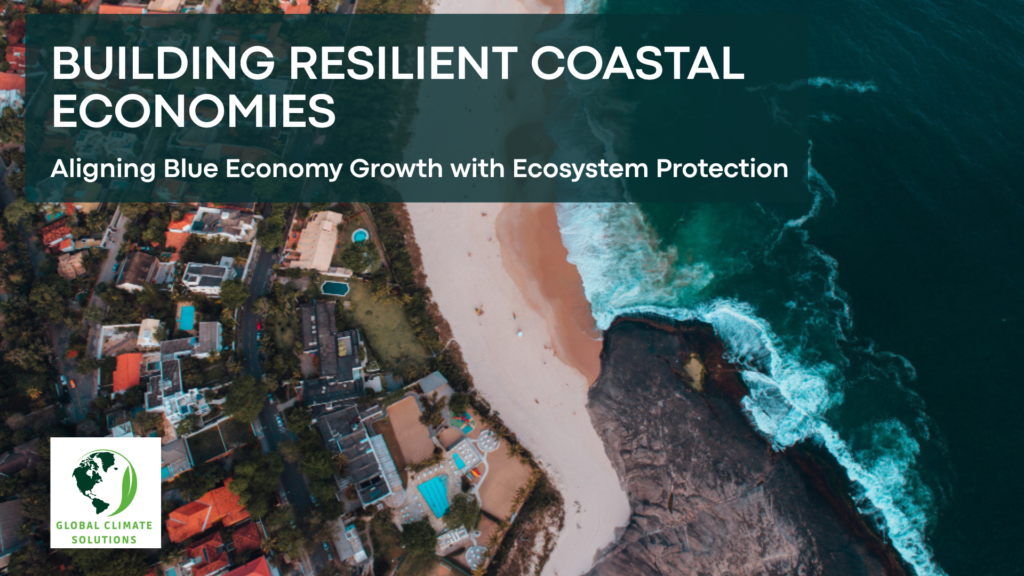
This week, we examine how blue economy strategies help coastal cities strengthen climate resilience while supporting sustainable economic growth.
🌊 Blue Economy Pathways for Resilient Coastal Cities
Coastal cities, central to global trade and tourism, face rising threats from sea-level rise, erosion, and storm surges. The blue economy provides a balanced model for growth by integrating sustainable ocean-based activities into urban planning.
Through this approach, cities can reduce long-term climate risks while benefiting from healthy marine ecosystems, which act as natural buffers and lower future disaster recovery costs.
🌱 Ecosystem Restoration as Urban Coastal Protection
Restoring coastal ecosystems—especially mangroves—is one of the most effective resilience strategies for urban shorelines. Mangroves stabilize coastlines, reduce wave intensity, store carbon, and support fisheries and ecotourism.
By investing in mangrove restoration and conservation, cities strengthen natural defenses, enhance biodiversity, and align urban development with blue economy principles that prioritize both environmental health and economic vitality.
🔆 Case Study: Sundari Mangrove Restoration Project, Indian Sundarbans
A major community-based initiative is restoring 4,000 hectares of degraded urban mangroves in the Indian Sundarbans. Led by EcoAct and Meensou India, the project supports local livelihoods, employs over 450 families—more than half women—and plants 19 native mangrove species.
With 600,000 trees planted and nearly 1,000 tCO2e sequestered per hectare, the project protects 1,434 fauna species and strengthens climate resilience across one of the world’s most vulnerable coastal regions.
📖 Read More
Read the full article by Robert C. Brears to explore how blue economy strategies and mangrove restoration are reshaping coastal resilience in rapidly growing cities.
Key Takeaways
Coastal cities can thrive sustainably by integrating blue economy principles, restoring mangroves, and aligning urban development with ecosystem protection. These strategies build resilience, strengthen livelihoods, and safeguard coastal environments.
Newly Published: Circular Economy and Liveable Cities (Cambridge University Press)
The Circular Economy and Liveable Cities, edited by Robert C. Brears, Our Future Water, has been published. This essential guide delivers actionable strategies and best practices for implementing circular economy, climate resilience, and sustainability in urban environments, with global examples from leading cities like Tokyo, New York, and Singapore to help planners, policymakers, and researchers build liveable and sustainable cities for the future.
📘 Coming Soon — 2nd Edition of Nature-Based Solutions to 21st Century Challenges (Routledge)
Fully revised and updated, the second edition of Nature-Based Solutions to 21st Century Challenges by Robert C. Brears offers a timely and systematic review of how working with nature can address today’s most pressing environmental and societal issues. Featuring new case studies from across the globe, expanded insights on public policy, AI, and community-led initiatives, this edition is essential reading for anyone shaping a sustainable future.
📚 Explore the Full Book Collection on Nature-Based Solutions (NBS)
Harness the power of nature to tackle today’s climate and development challenges. Curated by Our Future Water and Global Climate Solutions, this collection offers practical frameworks for embedding NBS into policy, planning, and implementation.
🌱 Strategies for integrating NBS into planning, finance, and ecosystem restoration
🌍 Approaches that enhance biodiversity, climate adaptation, and resilience
📘 Tools for applying NBS across sectors and governance systems
Click here to explore the complete collection.
📚 Shape the Future of Sustainability: Contribute to Springer Nature’s Landmark Publications
As Editor-in-Chief, Robert C. Brears invites experts, researchers, and practitioners to contribute to impactful and forward-thinking publications from Springer Nature. These comprehensive Handbooks and Encyclopedias explore Nature-Based Solutions, sustainable resource management, ecosystem well-being, and the global energy transition.
- Palgrave Handbook of Nature-Based Solutions
- Palgrave Encyclopedia of Sustainable Resources and Ecosystem Resilience
- Palgrave Handbook of Ecosystems and Human Well-Being
- Palgrave Handbook of Energy Transition and Renewable Energy
- Palgrave Handbook of Urban Climate and Disaster Resilience
- Palgrave Handbook of Social Transformations in Science, Innovation, and Education
📚 Shape the Future of Climate Resilience: Contribute to Palgrave’s Pivot Series
As Series Editor, Robert C. Brears invites experts to contribute to Palgrave Studies in Climate Resilient Societies, a leading Pivot series (25,000–50,000 words) exploring climate resilience, policy innovation, and sustainability strategies.
📩 For more details, visit: Seeking Authors — Palgrave Studies in Climate Resilient Societies