🌍 Global Climate Solutions
Exploring the intersection of technology, economics, and environmental stewardship.
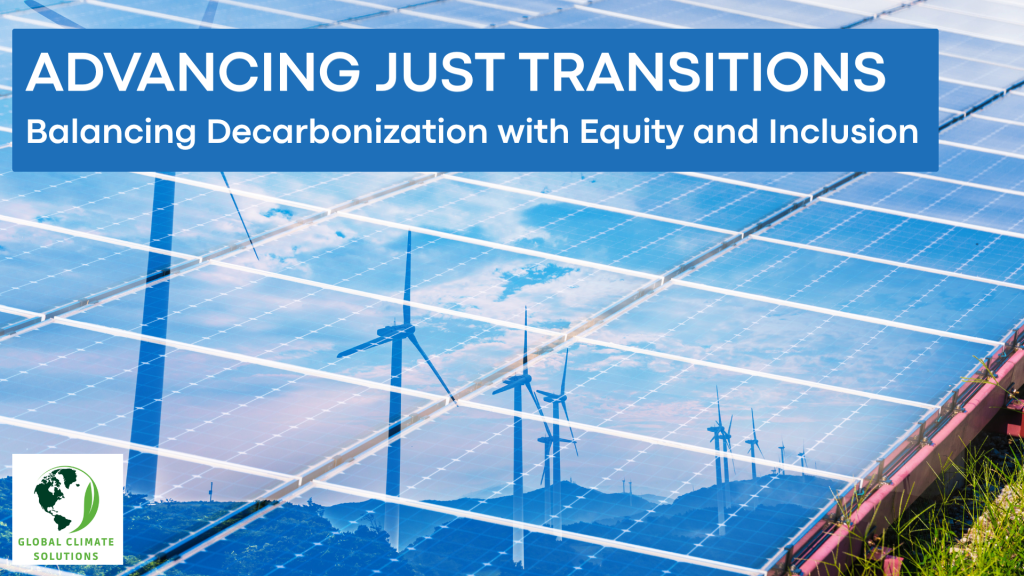
This week, we highlight how the Just Energy Transition is reshaping climate action by combining decarbonization with fairness and inclusivity.
⚡ Just Energy Transition: Fairness in Climate Action
The Just Energy Transition addresses climate change while safeguarding workers and communities reliant on fossil fuels. It balances rapid decarbonization with retraining, social safety nets, and new green economic opportunities.
Equity is central, as vulnerable communities and developing nations—least responsible for emissions—face disproportionate climate risks. Access to affordable, sustainable energy is a core humanitarian goal of this transition.
🤝 Collaboration for Inclusive Energy Systems
Governments, businesses, and civil society must work together to ensure policies are sustainable and socially inclusive. Supportive investment, fair labor practices, and resilient energy infrastructure are key to achieving a just transition.
🔆 Case Study: Indonesia’s $20B Just Energy Transition Partnership
Launched at the G20 Summit, JETP Indonesia mobilizes $20B in public and private funding to accelerate renewables, retire coal plants early, and strengthen grids. Its “living” investment plan ensures balance, inclusivity, and sustainability.
📖 Read More
Read the full article by Robert C. Brears to explore how just energy transitions align climate goals with social justice. Learn from Indonesia’s JETP and global efforts toward inclusive decarbonization.
Key Takeaways
The Just Energy Transition ensures climate action is both sustainable and equitable. By combining decarbonization with fairness, nations can reduce emissions while protecting communities and fostering long-term growth.
WATER-FOOD NEXUS Webinar Series: Circularity, Innovation & Sustainability
Join our four-part online webinar series by EIT Food and Our Future Water to build skills in systems thinking, design innovation, nature-based strategies, and sustainable financing. Learn live, connect globally, and gain practical tools to advance circular, resilient water-food systems — all from anywhere in the world.
PUBLISHED: Circular Economy and Liveable Cities (Cambridge University Press)
The Circular Economy and Liveable Cities, edited by Robert C. Brears, Our Future Water, has been published. This essential guide delivers actionable strategies and best practices for implementing circular economy, climate resilience, and sustainability in urban environments, with global examples from leading cities like Tokyo, New York, and Singapore to help planners, policymakers, and researchers build liveable and sustainable cities for the future.
📘 Coming Soon — 2nd Edition of Nature-Based Solutions to 21st Century Challenges (Routledge)
Fully revised and updated, the second edition of Nature-Based Solutions to 21st Century Challenges by Robert C. Brears offers a timely and systematic review of how working with nature can address today’s most pressing environmental and societal issues. Featuring new case studies from across the globe, expanded insights on public policy, AI, and community-led initiatives, this edition is essential reading for anyone shaping a sustainable future.
📚 Shape the Future of Sustainability: Contribute to Springer Nature’s Landmark Publications
As Editor-in-Chief, Robert C. Brears invites experts, researchers, and practitioners to contribute to impactful and forward-thinking publications from Springer Nature. These comprehensive Handbooks and Encyclopedias explore Nature-Based Solutions, sustainable resource management, ecosystem well-being, and the global energy transition.
- Palgrave Handbook of Nature-Based Solutions
- Palgrave Encyclopedia of Sustainable Resources and Ecosystem Resilience
- Palgrave Handbook of Ecosystems and Human Well-Being
- Palgrave Handbook of Energy Transition and Renewable Energy
- Palgrave Handbook of Urban Climate and Disaster Resilience
- Palgrave Handbook of Social Transformations in Science, Innovation, and Education
📚 Shape the Future of Climate Resilience: Contribute to Palgrave’s Pivot Series
As Series Editor, Robert C. Brears invites experts to contribute to Palgrave Studies in Climate Resilient Societies, a leading Pivot series (25,000–50,000 words) exploring climate resilience, policy innovation, and sustainability strategies.
📩 For more details, visit: Seeking Authors — Palgrave Studies in Climate Resilient Societies