🌍 Global Climate Solutions
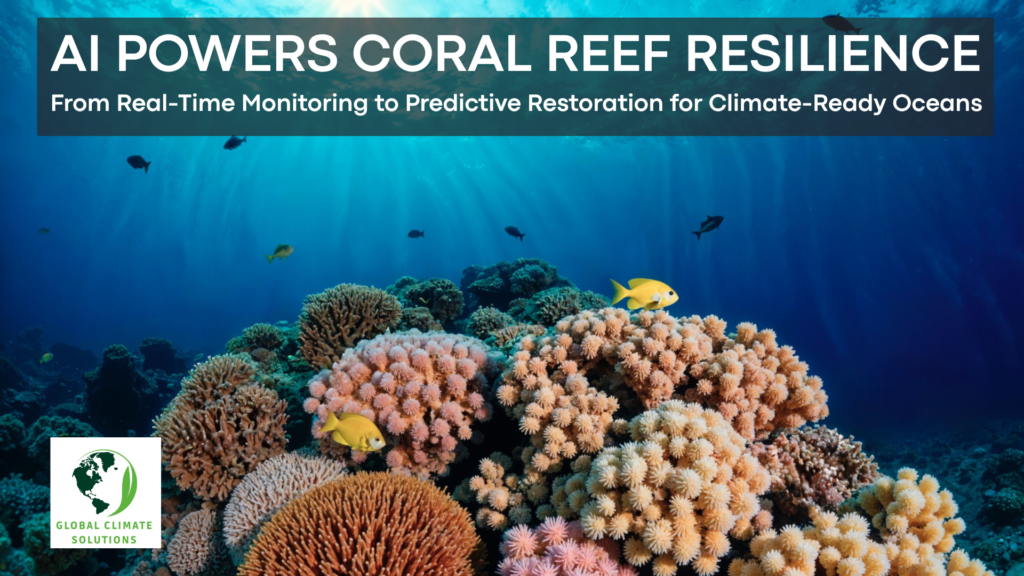
Exploring the intersection of technology, economics, and environmental stewardship. This week, we examine how artificial intelligence strengthens marine ecosystems by improving monitoring precision, accelerating restoration, and building climate resilience for coral reef systems under mounting environmental stress.
🪸 AI as a Digital Framework for Coral Reef Resilience
Artificial intelligence is emerging as an integrated digital framework for coral reef monitoring and restoration. By combining remote sensing, underwater robotics, satellite imagery, and machine learning, AI enables continuous ecosystem assessment and data-driven intervention.
This matters because coral reefs underpin fisheries, coastal protection, tourism economies, and biodiversity. Faster diagnostics, predictive analytics, and optimized restoration increase ecosystem stability while reducing resource waste and improving long-term marine resilience under climate stress.
📡 Real-Time Monitoring and Automated Reef Assessment
AI-powered tools analyze satellite imagery, underwater drone footage, and sensor data to map coral cover, detect bleaching, and assess ecosystem change at scale. Machine learning models classify reef composition and identify early signs of degradation with greater speed and consistency than manual surveys.
These automated assessments reduce human error and dramatically cut processing time, enabling more frequent and reliable monitoring cycles. The result is stronger marine resource governance, improved biodiversity protection, and more efficient allocation of conservation funding.
🔬 Predictive Modeling for Climate Adaptation
Machine learning models forecast how coral species respond to warming seas and ocean acidification. By simulating environmental stress scenarios, AI identifies coral varieties with higher tolerance thresholds for targeted restoration programs.
This predictive capacity shifts conservation from reactive to strategic. Selecting resilient species enhances long-term ecosystem recovery, supports fisheries productivity, and strengthens natural coastal defenses against climate-driven disturbances.
🌊 Optimizing Coral Seeding and Early Warning Systems
AI enhances coral seeding by modeling ocean currents and simulating larval dispersal to identify optimal settlement zones. Monitoring algorithms then track survival and growth rates, refining restoration strategies over time.
At the same time, AI-enabled early warning systems analyze real-time environmental data to detect bleaching risks and disease outbreaks. Proactive alerts allow conservation teams to intervene early, minimizing ecosystem loss and improving restoration returns on investment.
🔆 Case Study: ReefCloud — Accelerating Global Reef Monitoring
ReefCloud, developed by the Australian Institute of Marine Science with international partners, is an open-access digital platform supporting global coral reef monitoring. Designed to streamline data analysis and collaboration, it enables scientists worldwide to upload, process, and share reef imagery efficiently.
Using advanced machine learning, ReefCloud assesses reef composition with 80–90% accuracy and processes changes over time 700 times faster than traditional methods. The platform connects 2,477 users across 97 countries and supports analysis from over 10,000 monitoring sites through a centralized dashboard.
By standardizing and accelerating reef assessments, ReefCloud strengthens global coordination, enabling faster policy responses, improved marine stewardship, and more resilient reef ecosystems under climate pressure.
📖 Read More
Read the full article by Robert C. Brears to explore how AI-driven monitoring and restoration are transforming coral reef conservation through precision data, predictive modeling, and global collaboration. The article highlights how digital innovation strengthens ecosystem resilience while improving the efficiency and impact of marine conservation investments.
Key Takeaways
AI-driven coral reef conservation integrates remote sensing, automated image recognition, predictive climate modeling, larval dispersal optimization, and early warning systems into a cohesive digital resilience framework. Structured policy support, targeted investment in digital infrastructure, and international collaboration are essential to scaling these tools and safeguarding marine ecosystems in a warming world.
Circular Economy and Liveable Cities (Cambridge University Press)
The Circular Economy and Liveable Cities, edited by Robert C. Brears, Our Future Water, has been published. This essential guide delivers actionable strategies and best practices for implementing circular economy, climate resilience, and sustainability in urban environments, with global examples from leading cities like Tokyo, New York, and Singapore to help planners, policymakers, and researchers build liveable and sustainable cities for the future.
2nd Edition of Nature-Based Solutions to 21st Century Challenges (Routledge)
Fully revised and updated, the second edition of Nature-Based Solutions to 21st Century Challenges by Robert C. Brears offers a timely and systematic review of how working with nature can address today’s most pressing environmental and societal issues. Featuring new case studies from across the globe, expanded insights on public policy, AI, and community-led initiatives, this edition is essential reading for anyone shaping a sustainable future.
📚 Shape the Future of Sustainability: Contribute to Springer Nature’s Landmark Publications
As Editor-in-Chief, Robert C. Brears invites experts, researchers, and practitioners to contribute to impactful and forward-thinking publications from Springer Nature. These comprehensive Handbooks and Encyclopedias explore Nature-Based Solutions, sustainable resource management, ecosystem well-being, and the global energy transition.
- Palgrave Handbook of Nature-Based Solutions
- Palgrave Encyclopedia of Sustainable Resources and Ecosystem Resilience
- Palgrave Handbook of Ecosystems and Human Well-Being
- Palgrave Handbook of Energy Transition and Renewable Energy
- Palgrave Handbook of Urban Climate and Disaster Resilience
- Palgrave Handbook of Social Transformations in Science, Innovation, and Education
📚 Shape the Future of Climate Resilience: Contribute to Palgrave’s Pivot Series
As Series Editor, Robert C. Brears invites experts to contribute to Palgrave Studies in Climate Resilient Societies, a leading Pivot series (25,000–50,000 words) exploring climate resilience, policy innovation, and sustainability strategies.
📩 For more details, visit: Seeking Authors — Palgrave Studies in Climate Resilient Societies
📚 Explore the Full Book Collection on Green Economy & Innovation Pathways
Accelerate the shift to a low-carbon, inclusive future with expert insights from Our Future Water and Global Climate Solutions. This collection highlights the tools, technologies, and strategies driving resilient and sustainable economic transformation.
⚡ Policy frameworks for enabling sustainable, equitable growth
🔬 Innovations in clean technologies and future-focused business models
📘 Pathways for long-term systems change, resilience, and impact
Click here to explore the complete collection.