🌍 Global Climate Solutions
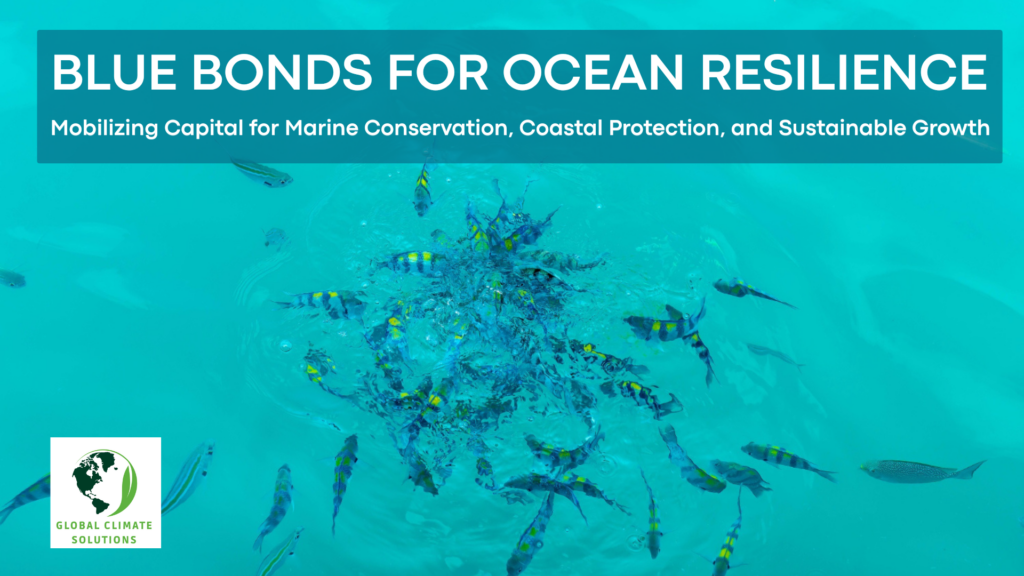
Exploring the intersection of technology, economics, and environmental stewardship. This week, we examine how blue bonds strengthen ocean and coastal systems by mobilizing capital for marine conservation, sustainable economic activity, climate resilience, and stronger water and resource security.
🌊 Blue Bonds as a Climate-Smart Ocean Finance Framework
Blue bonds are a targeted sustainable finance mechanism that channels capital into ocean- and marine-related projects with clear environmental and economic objectives. As a use-of-proceeds instrument, they connect investment with marine conservation, sustainable fisheries, ocean-based renewable energy, pollution reduction, and water-related infrastructure while supporting resilience, livelihoods, and long-term resource security.
🏦 Market Structure and Capital Mobilization
Blue bonds are issued by sovereign governments, municipalities, development banks, and corporations to fund marine projects under recognized sustainability frameworks. Their structure links financing to specific ocean outcomes, helping align public policy goals with investor demand for long-term, fixed-income instruments.
This approach broadens the pool of capital available for marine infrastructure, conservation, and coastal development. It also helps de-risk investment when public institutions and private actors work together, improving the prospects for projects that support economic resilience, biodiversity, and sustainable ocean industries.
⚓ Investment Pathways for Sustainable Marine Infrastructure
Private blue bonds can support offshore wind, aquaculture expansion, and lower-impact maritime transport, while sovereign blue bonds can fund national-scale ocean conservation and marine development strategies. Their longer maturities and fixed-rate profiles make them particularly suited to investors such as pension funds and insurers seeking stable returns.
These financing pathways can unlock capital for sectors that are often underfunded despite their strategic importance to food systems, coastal economies, and climate adaptation. In practice, they help direct investment toward projects that improve livelihoods, strengthen coastal resilience, and reduce pressure on marine ecosystems.
📊 Accountability, Verification, and Financing Constraints
For blue bonds to deliver credibility, issuers must demonstrate that proceeds are allocated only to eligible marine sustainability projects. That requires monitoring, reporting, and verification systems aligned with recognized principles, which can add cost and administrative complexity.
At the same time, pricing depends on issuer credit quality, so blue bonds are not automatically cheaper than conventional debt, and strict earmarking can reduce fiscal flexibility. These constraints mean strong governance, transparent reporting, and well-designed program structures are essential to ensure environmental impact and investor confidence.
🌐 Policy Alignment and Ocean Economy Outcomes
Blue bonds sit at the intersection of environmental policy, development finance, and ocean economy strategy. By aligning with sustainability standards and broader development goals, they create a practical bridge between marine stewardship and long-term economic planning.
This integration can deliver multiple gains at once: healthier marine ecosystems, stronger climate resilience, improved water and waste management, and more secure coastal livelihoods. It also gives governments and institutions a mechanism to scale ocean-focused investment without separating environmental priorities from growth and infrastructure needs.
🔆 Case Study: Fiji Sovereign Blue Bond — Mobilizing Capital for Coastal Resilience
Fiji launched its first sovereign blue bond to attract private investment for ocean conservation and sustainable marine development in a context of high exposure to climate change, sea-level rise, and marine resource degradation. Introduced in November 2023 with an issuance ceiling of FJD 20 million, the program targets nature-based coastal protection, sustainable aquaculture, blue urban development, and improved waste and water management.
The bond was supported by the United Kingdom’s Blue Planet Fund and the United Nations Development Programme Pacific Office, with the Reserve Bank of Fiji facilitating issuance and helping reinforce market confidence. Its structure included three-year bonds at a 1% fixed coupon rate and fifteen-year bonds at a 4.2% fixed rate, creating a defined framework for channeling capital into marine sustainability measures.
In practice, the program translates blue finance into concrete interventions, from ecosystem-based coastal protection for vulnerable communities to hatchery expansion for sea cucumbers, seaweed, and shrimp, as well as wastewater treatment and landfill improvements. This shows how sovereign-backed finance can support resilience, strengthen marine ecosystems, and direct investment toward projects that may not otherwise attract private capital.
📖 Read More
Read the full article by Robert C. Brears to explore how blue bonds connect marine conservation with investment strategy, climate resilience, and sustainable development. The article shows how structured blue finance can strengthen ocean health, support livelihoods, and improve long-term water and coastal resource security.
Key Takeaways
Blue bonds provide an integrated ocean finance framework that combines targeted capital allocation, sustainability standards, marine infrastructure investment, ecosystem protection, and water and waste management to strengthen resilience, livelihoods, and long-term resource security. Structured policy support, transparent verification, targeted investment, and strong public-private and multi-level institutional partnerships are central to scaling blue bond finance and building resilient, low-carbon, resource-secure ocean economies.
Circular Economy and Liveable Cities (Cambridge University Press)
The Circular Economy and Liveable Cities, edited by Robert C. Brears, Our Future Water, has been published. This essential guide delivers actionable strategies and best practices for implementing circular economy, climate resilience, and sustainability in urban environments, with global examples from leading cities like Tokyo, New York, and Singapore to help planners, policymakers, and researchers build liveable and sustainable cities for the future.
2nd Edition of Nature-Based Solutions to 21st Century Challenges (Routledge)
Fully revised and updated, the second edition of Nature-Based Solutions to 21st Century Challenges by Robert C. Brears offers a timely and systematic review of how working with nature can address today’s most pressing environmental and societal issues. Featuring new case studies from across the globe, expanded insights on public policy, AI, and community-led initiatives, this edition is essential reading for anyone shaping a sustainable future.
📚 Contribute to Springer Nature’s Landmark Publications
As Editor-in-Chief, Robert C. Brears invites experts, researchers, and practitioners to contribute to impactful and forward-thinking publications from Springer Nature. These comprehensive Handbooks and Encyclopedias explore Nature-Based Solutions, sustainable resource management, ecosystem well-being, and the global energy transition.
- Palgrave Handbook of Nature-Based Solutions
- Palgrave Encyclopedia of Sustainable Resources and Ecosystem Resilience
- Palgrave Handbook of Energy Transition and Renewable Energy
- Palgrave Handbook of Urban Climate and Disaster Resilience
- Palgrave Handbook of Social Transformations in Science, Innovation, and Education
📚 Contribute to Palgrave’s Pivot Series on Climate Resilient Societies
As Series Editor, Robert C. Brears invites experts to contribute to Palgrave Studies in Climate Resilient Societies, a leading Pivot series (25,000–50,000 words) exploring climate resilience, policy innovation, and sustainability strategies.
📩 For more details, visit: Seeking Authors — Palgrave Studies in Climate Resilient Societies