🌍 Global Climate Solutions
Exploring the intersection of technology, economics, and environmental stewardship.
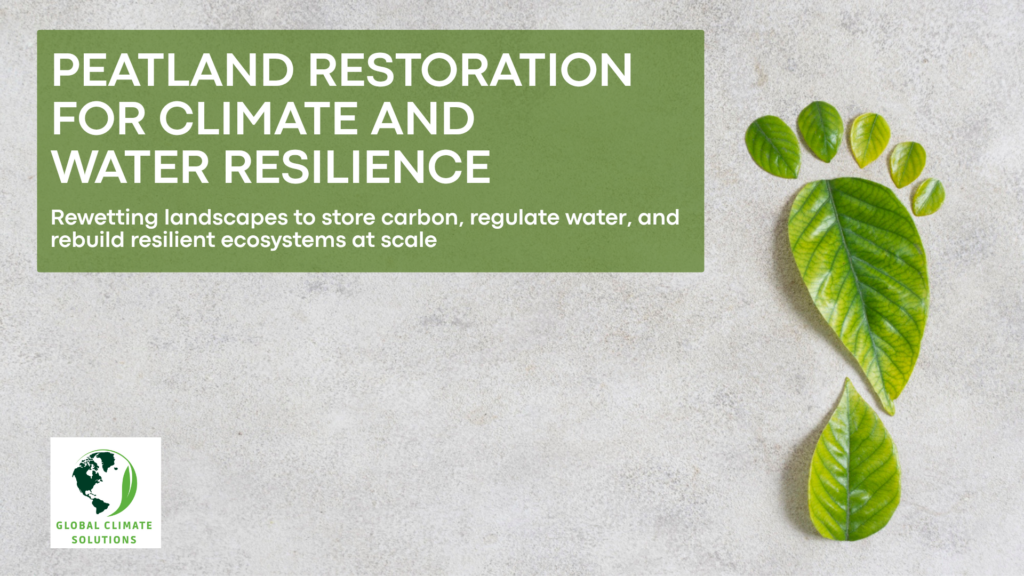
This week, we examine how peatland restoration and nature-based solutions strengthen climate and water systems by enhancing carbon storage, regulating hydrology, and improving ecosystem resilience.
🌿 Peatland Restoration as a Climate-Smart Ecosystem Strategy
Peatland restoration is a climate-smart land and water management approach that rehabilitates degraded peat ecosystems through rewetting, vegetation recovery, and hydrological repair. As one of the largest terrestrial carbon stores, peatlands play a critical role in reducing emissions while supporting biodiversity and water regulation.
By restoring these ecosystems, countries can simultaneously enhance carbon sequestration, stabilize water cycles, and support livelihoods dependent on healthy landscapes. This integrated framework links emissions reduction with resilience and long-term resource security.
⚙️ Hydrological Recovery and Carbon Stabilization
Restoration focuses on rewetting drained peatlands by blocking ditches, installing peat dams, and raising water tables to halt oxidation. Reintroducing sphagnum mosses and stabilizing exposed peat surfaces enables the gradual rebuilding of peat-forming processes.
These interventions shift peatlands from net carbon sources to sinks over time, significantly reducing greenhouse gas emissions. At the same time, restored hydrology limits land degradation and enhances long-term ecosystem stability.
💧 Water Regulation and Landscape Resilience
Peatlands function as natural water storage systems, absorbing rainfall and releasing it slowly across landscapes. Restoration improves this capacity by re-establishing saturated conditions that regulate water flow and reduce rapid runoff.
This leads to lower flood risks during heavy rainfall and improved drought resilience during dry periods. Enhanced water quality and reduced sedimentation also benefit downstream ecosystems, agriculture, and water supply systems.
🌱 Biodiversity Recovery and Sustainable Livelihoods
Rewetted peatlands create habitats for specialized and often endangered species, supporting biodiversity recovery at scale. Native vegetation re-establishment strengthens ecosystem functions and promotes ecological balance.
At the same time, restoration generates economic opportunities through conservation jobs, eco-tourism, and carbon markets. Improved soil moisture and reduced land degradation also support more sustainable agricultural practices in surrounding areas.
🔆 Case Study: Peatland ACTION, Scotland — Scaling Restoration for Net Zero
Peatland ACTION is a national program funded by the Scottish Government and delivered with NatureScot and national park authorities to restore degraded peatlands. With over £250 million committed, the initiative aims to restore 250,000 hectares by 2030 and has already rehabilitated more than 51,000 hectares.
The program provides financial support to land managers for restoration activities such as peat dam construction, drainage blocking, and vegetation recovery. Larger projects require formal procurement processes, while multi-year funding enables long-term restoration at scale.
By restoring hydrological function and preventing further peat decomposition, the initiative contributes directly to Scotland’s net-zero strategy. It also creates jobs, builds technical expertise, and has received multiple awards for advancing climate resilience and landscape restoration.
📖 Read More
Read the full article by Robert C. Brears to explore how peatland restoration integrates climate mitigation, water management, and biodiversity conservation into a unified strategy. The article highlights how nature-based solutions deliver measurable gains in resilience, emissions reduction, and sustainable development.
Key Takeaways
Peatland restoration combines hydrological repair, vegetation recovery, and ecosystem management to deliver carbon sequestration, water regulation, biodiversity gains, and livelihood support. Scaling these outcomes depends on strong policy frameworks, sustained public and private investment, and coordinated partnerships that enable large-scale, long-term restoration.
Circular Economy and Liveable Cities (Cambridge University Press)
The Circular Economy and Liveable Cities, edited by Robert C. Brears, Our Future Water, has been published. This essential guide delivers actionable strategies and best practices for implementing circular economy, climate resilience, and sustainability in urban environments, with global examples from leading cities like Tokyo, New York, and Singapore to help planners, policymakers, and researchers build liveable and sustainable cities for the future.
2nd Edition of Nature-Based Solutions to 21st Century Challenges (Routledge)
Fully revised and updated, the second edition of Nature-Based Solutions to 21st Century Challenges by Robert C. Brears offers a timely and systematic review of how working with nature can address today’s most pressing environmental and societal issues. Featuring new case studies from across the globe, expanded insights on public policy, AI, and community-led initiatives, this edition is essential reading for anyone shaping a sustainable future.
📚 Contribute to Springer Nature’s Landmark Publications
As Editor-in-Chief, Robert C. Brears invites experts, researchers, and practitioners to contribute to impactful and forward-thinking publications from Springer Nature. These comprehensive Handbooks and Encyclopedias explore Nature-Based Solutions, sustainable resource management, ecosystem well-being, and the global energy transition.
- Palgrave Handbook of Nature-Based Solutions
- Palgrave Encyclopedia of Sustainable Resources and Ecosystem Resilience
- Palgrave Handbook of Energy Transition and Renewable Energy
- Palgrave Handbook of Urban Climate and Disaster Resilience
- Palgrave Handbook of Social Transformations in Science, Innovation, and Education
📚 Contribute to Palgrave’s Pivot Series on Climate Resilient Societies
As Series Editor, Robert C. Brears invites experts to contribute to Palgrave Studies in Climate Resilient Societies, a leading Pivot series (25,000–50,000 words) exploring climate resilience, policy innovation, and sustainability strategies.
📩 For more details, visit: Seeking Authors — Palgrave Studies in Climate Resilient Societies