Manufacturing executives and plant leaders
For decision-makers balancing decarbonisation with production, reliability, safety, product quality and competitiveness.

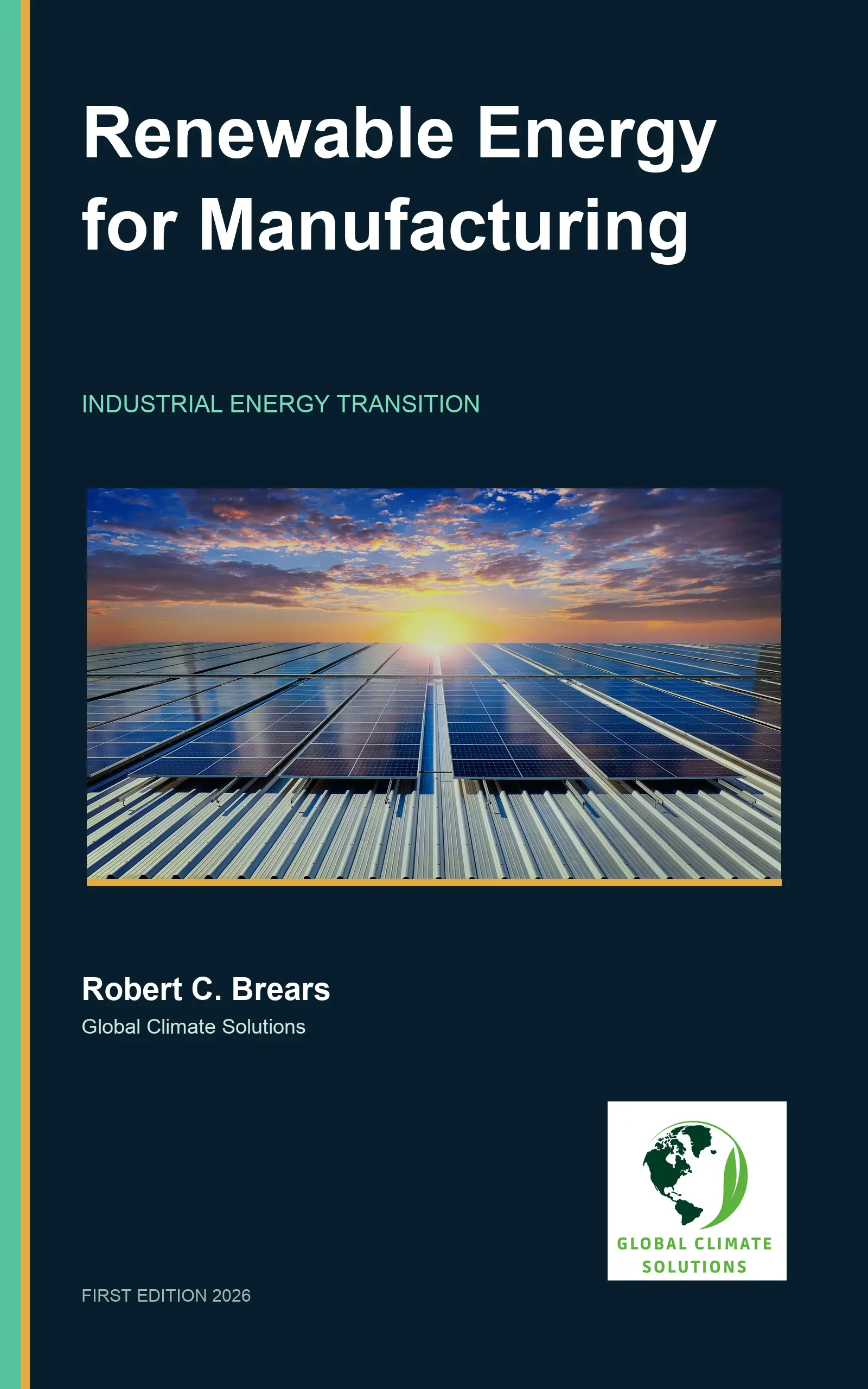
Manufacturers face an unforgiving energy transition: reduce emissions without sacrificing output, product quality, safety, reliability, or competitiveness.
Renewable Energy for Manufacturing turns that tension into a practical decision framework for industrial leaders. Rather than presenting a single technology as the answer, Robert C. Brears shows how to build a sequenced transition around the realities of each plant—its loads, process-heat requirements, assets, contracts, risks, and investment constraints.
Readers will see how energy efficiency can reduce the scale of the challenge; how to evaluate renewable electricity, on-site generation, electrification, renewable fuels, storage, and flexibility; and how to translate technical options into resilient business cases. The book also examines financing, supply chains, industrial competitiveness, and the governance needed to adapt as technologies, markets, and operating conditions change.
For manufacturing executives, engineers, and energy and sustainability professionals, this is a disciplined guide to deciding what to do first, what to defer, and how to move from ambition to an investable renewable-energy strategy.
Map plant energy demand, process-heat requirements, asset constraints and operational risks before selecting technologies.
Use energy efficiency as the first transition resource to reduce demand, cost and the scale of later investments.
Compare renewable electricity procurement, on-site generation and contractual options against plant-specific requirements.
Evaluate electrification and renewable fuels for industrial heat and processes where direct renewable electricity is insufficient.
Design flexibility, storage and resilience measures that protect output, safety, quality and reliability.
Translate technical pathways into investable business cases using finance, risk and sequencing discipline.
Coordinate governance, supply chains and implementation so the transition strengthens industrial competitiveness over time.
Manufacturing's Energy Transition
Manufacturing Energy Systems and Transition Imperatives
Energy Efficiency as the First Transition Resource
Renewable Electricity Procurement and On-Site Generation
Electrifying Industrial Heat and Processes
Renewable Fuels and Molecular Energy Carriers
Flexibility, Storage, and Industrial Energy Resilience
Financing, Investment, and Business-Case Design
Supply Chains, Markets, and Industrial Competitiveness
Governance, Implementation, and the Industrial Transition Ahead
A Disciplined Route to Renewable Manufacturing
For decision-makers balancing decarbonisation with production, reliability, safety, product quality and competitiveness.
For technical teams comparing efficiency, renewable electricity, electrification, fuels, storage and flexible operations.
For practitioners building plant-specific transition pathways, emissions strategies and implementation roadmaps.
For specialists translating technical options into sequenced, risk-aware and investable business cases.
For leaders shaping markets, infrastructure, supply chains and governance for competitive low-carbon manufacturing.

Robert C. Brears is the founder and editor-in-chief of Global Climate Solutions. His work connects climate resilience, water security, nature-based solutions, sustainable finance and the transition to more resilient cities and industries.
View author profile →A practical guide to sequencing renewable energy, efficiency, electrification, storage and finance in manufacturing.

Japan’s sovereign transition bonds connect public capital with industrial technology development, infrastructure needs, and transparent reporting.

Shared reuse services need convenient returns, dependable cleaning, and clear operating roles. Banff offers practical lessons for connecting these requirements.

Germany’s MiSpeL framework connects battery storage and bidirectional charging with electricity-market participation through clearer measurement and settlement rules.