🌍 Global Climate Solutions
Exploring the intersection of technology, economics, and environmental stewardship.
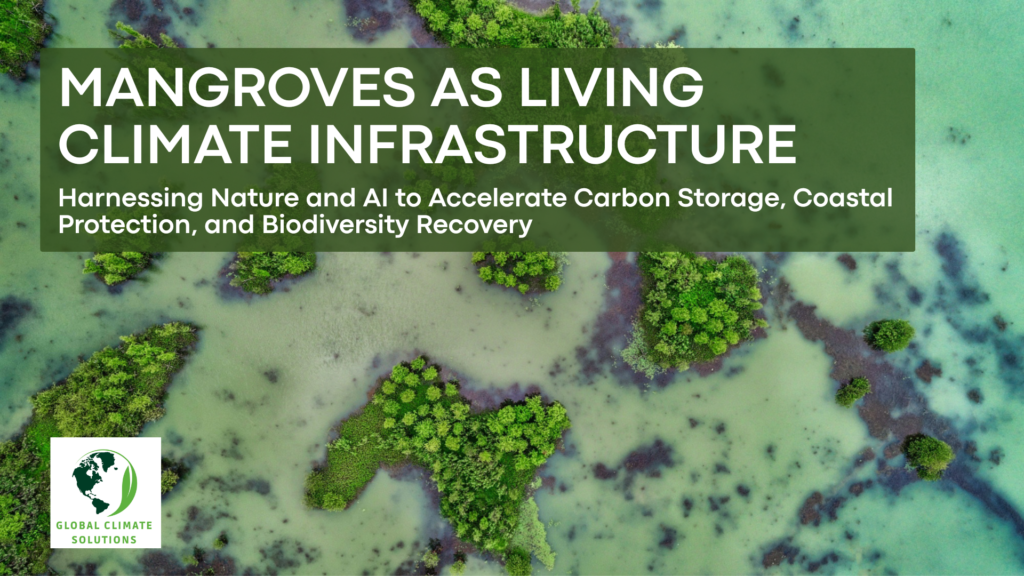
This week, we examine why mangroves are essential for climate mitigation and adaptation—and how artificial intelligence (AI) is redefining ecosystem restoration.
🌱🌊 Mangroves as Climate Mitigation and Adaptation Powerhouses
Mangroves are among the most effective natural carbon sinks, storing up to five times more carbon per unit area than terrestrial forests. Their dense root systems trap organic material in coastal soils, locking carbon away for centuries and preventing its release into the atmosphere.
Beyond mitigation, mangroves play a critical role in climate adaptation. They stabilize coastlines, reduce wave energy, protect against storm surges, and limit erosion, making them indispensable for safeguarding coastal cities and communities facing rising sea levels and extreme weather.
🐟 Reversing Biodiversity Loss Through Mangrove Restoration
Mangroves are biodiversity hotspots that support interconnected marine and terrestrial ecosystems. Acting as nurseries for fish and crustaceans, they underpin fisheries and food security while providing habitat for birds, reptiles, and mammals.
When mangroves are lost to deforestation or land conversion, biodiversity declines rapidly and ecosystem balance is disrupted. Restoration reverses these trends by rebuilding habitats, strengthening ecological connectivity, and supporting livelihoods tied to healthy coastal systems.
🤖 AI as a Catalyst for Mangrove Conservation
AI is transforming how mangrove restoration is planned, implemented, and monitored. AI-powered mapping tools analyze soil conditions, hydrology, and vegetation density to identify sites where restoration is most likely to succeed.
Drones guided by AI can distribute seeds in patterns that mimic natural regeneration, reducing human disturbance in fragile ecosystems. Continuous AI-based monitoring then tracks growth and survival rates, enabling adaptive management and improving long-term restoration outcomes at scale.
🔆 Case Study: Nabat.ai:AI and Robotics for Mangrove Restoration
Nabat.ai is an AI-driven mangrove restoration initiative developed by the Advanced Technology Research Council in the UAE. The system integrates precision habitat mapping, drone-based seeding, and real-time monitoring to improve mangrove regeneration success.
By identifying suitable restoration sites and deploying seeds in ecosystem-specific patterns, the initiative minimizes ecological disruption while increasing effectiveness. Ongoing monitoring allows teams to refine strategies where survival rates are low. While initially focused on UAE mangroves, the model is scalable to other ecosystems, including forests, deserts, and coral reefs.
📖 Read More
Read the full article by Robert C. Brears to explore how mangroves support climate resilience and how AI-driven restoration is reshaping global conservation strategies.
Key Takeaways
Mangroves are critical for carbon storage, climate adaptation, and biodiversity protection. Integrating AI and robotics into restoration efforts enables smarter, scalable, and ecosystem-specific solutions for long-term coastal resilience.
Circular Economy and Liveable Cities (Cambridge University Press)
The Circular Economy and Liveable Cities, edited by Robert C. Brears, Our Future Water, has been published. This essential guide delivers actionable strategies and best practices for implementing circular economy, climate resilience, and sustainability in urban environments, with global examples from leading cities like Tokyo, New York, and Singapore to help planners, policymakers, and researchers build liveable and sustainable cities for the future.
2nd Edition of Nature-Based Solutions to 21st Century Challenges (Routledge)
Fully revised and updated, the second edition of Nature-Based Solutions to 21st Century Challenges by Robert C. Brears offers a timely and systematic review of how working with nature can address today’s most pressing environmental and societal issues. Featuring new case studies from across the globe, expanded insights on public policy, AI, and community-led initiatives, this edition is essential reading for anyone shaping a sustainable future.
Shape the Future of Sustainability: Contribute to Springer Nature’s Landmark Publications
As Editor-in-Chief, Robert C. Brears invites experts, researchers, and practitioners to contribute to impactful and forward-thinking publications from Springer Nature. These comprehensive Handbooks and Encyclopedias explore Nature-Based Solutions, sustainable resource management, ecosystem well-being, and the global energy transition.
- Palgrave Handbook of Nature-Based Solutions
- Palgrave Encyclopedia of Sustainable Resources and Ecosystem Resilience
- Palgrave Handbook of Ecosystems and Human Well-Being
- Palgrave Handbook of Energy Transition and Renewable Energy
- Palgrave Handbook of Urban Climate and Disaster Resilience
- Palgrave Handbook of Social Transformations in Science, Innovation, and Education
Shape the Future of Climate Resilience: Contribute to Palgrave’s Pivot Series
As Series Editor, Robert C. Brears invites experts to contribute to Palgrave Studies in Climate Resilient Societies, a leading Pivot series (25,000–50,000 words) exploring climate resilience, policy innovation, and sustainability strategies.
For more details, visit: Seeking Authors — Palgrave Studies in Climate Resilient Societies
Explore the Full Book Collection on Green Economy & Innovation Pathways
Accelerate the shift to a low-carbon, inclusive future with expert insights from Our Future Water and Global Climate Solutions. This collection highlights the tools, technologies, and strategies driving resilient and sustainable economic transformation.
- Policy frameworks for enabling sustainable, equitable growth
- Innovations in clean technologies and future-focused business models
- Pathways for long-term systems change, resilience, and impact
Click here to explore the complete collection.