🌍 Global Climate Solutions
Exploring the intersection of technology, economics, and environmental stewardship.
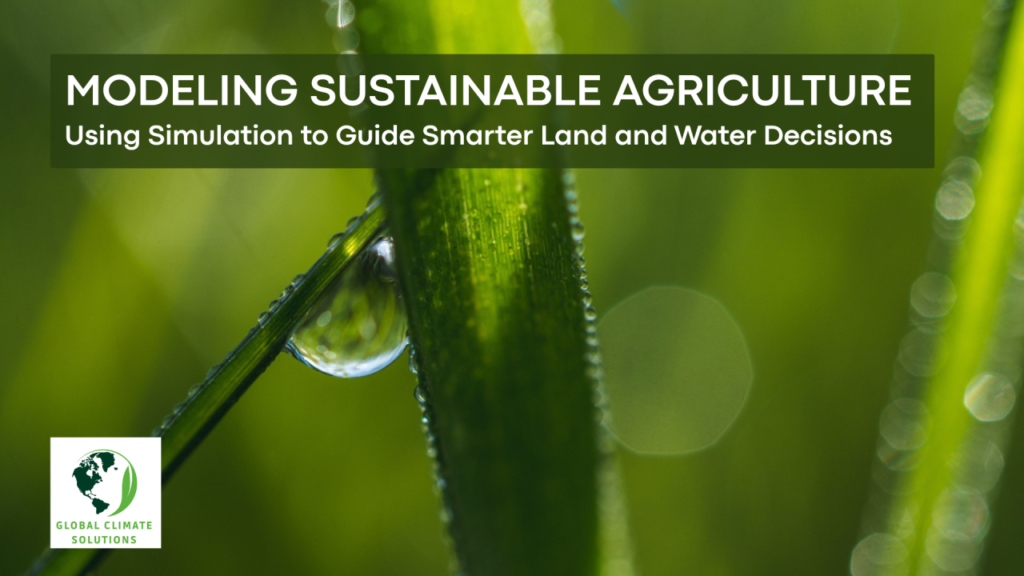
This week, we explore how simulation models are transforming agricultural decision-making and supporting more sustainable land and water management.
🌾 Simulation Tools for Sustainable Agricultural Management
Simulations are increasingly used to assess how agricultural practices influence runoff, sediment transport, and nutrient losses. By modeling real-world conditions, these tools help evaluate the environmental impacts of farming decisions before they are implemented.
They enable producers, planners, and policymakers to identify strategies that reduce pollution while maintaining productivity, supporting the transition toward more resilient agricultural systems.
🧪 From Nutrient Management to Conservation Practices
Simulation models assess fertilizer timing, application rates, and tillage methods to identify conditions that increase nutrient runoff and erosion. They also evaluate conservation practices such as cover crops, buffer strips, and reduced tillage, showing how these measures improve soil structure and reduce pollutant transport.
By modeling alternative cropping systems and integrated management approaches, simulations provide a comprehensive understanding of how combined practices influence soil health, water quality, and long-term sustainability.
🔆 Case Study: Texas A&M AgriLife’s APEX Model
The APEX model developed by Texas A&M AgriLife simulates water, sediment, nutrient, and pesticide movement across agricultural landscapes. By dividing watersheds into detailed subareas, the model evaluates grazing systems, crop rotations, and tillage practices under varying climatic and management scenarios.
APEX also incorporates carbon and nitrogen cycling, enabling analysis of greenhouse gas emissions and soil carbon storage. These capabilities support data-driven decisions that balance agricultural productivity with environmental protection.
📖 Read More
Read the full article by Robert C. Brears to discover how simulation tools like APEX support sustainable agriculture, improve water quality, and guide evidence-based land management decisions.
Key Takeaways
Simulation models provide actionable insights into reducing runoff, erosion, and nutrient losses in agriculture. By supporting data-driven decisions, they help align productivity with long-term environmental sustainability.
Circular Economy and Liveable Cities (Cambridge University Press)
The Circular Economy and Liveable Cities, edited by Robert C. Brears, Our Future Water, has been published. This essential guide delivers actionable strategies and best practices for implementing circular economy, climate resilience, and sustainability in urban environments, with global examples from leading cities like Tokyo, New York, and Singapore to help planners, policymakers, and researchers build liveable and sustainable cities for the future.
2nd Edition of Nature-Based Solutions to 21st Century Challenges (Routledge)
Fully revised and updated, the second edition of Nature-Based Solutions to 21st Century Challenges by Robert C. Brears offers a timely and systematic review of how working with nature can address today’s most pressing environmental and societal issues. Featuring new case studies from across the globe, expanded insights on public policy, AI, and community-led initiatives, this edition is essential reading for anyone shaping a sustainable future.
📚 Shape the Future of Sustainability: Contribute to Springer Nature’s Landmark Publications
As Editor-in-Chief, Robert C. Brears invites experts, researchers, and practitioners to contribute to impactful and forward-thinking publications from Springer Nature. These comprehensive Handbooks and Encyclopedias explore Nature-Based Solutions, sustainable resource management, ecosystem well-being, and the global energy transition.
- Palgrave Handbook of Nature-Based Solutions
- Palgrave Encyclopedia of Sustainable Resources and Ecosystem Resilience
- Palgrave Handbook of Ecosystems and Human Well-Being
- Palgrave Handbook of Energy Transition and Renewable Energy
- Palgrave Handbook of Urban Climate and Disaster Resilience
- Palgrave Handbook of Social Transformations in Science, Innovation, and Education
📚 Shape the Future of Climate Resilience: Contribute to Palgrave’s Pivot Series
As Series Editor, Robert C. Brears invites experts to contribute to Palgrave Studies in Climate Resilient Societies, a leading Pivot series (25,000–50,000 words) exploring climate resilience, policy innovation, and sustainability strategies.
📩 For more details, visit: Seeking Authors — Palgrave Studies in Climate Resilient Societies
📚 Explore the Full Book Collection on Green Economy & Innovation Pathways
Accelerate the shift to a low-carbon, inclusive future with expert insights from Our Future Water and Global Climate Solutions. This collection highlights the tools, technologies, and strategies driving resilient and sustainable economic transformation.
⚡ Policy frameworks for enabling sustainable, equitable growth
🔬 Innovations in clean technologies and future-focused business models
📘 Pathways for long-term systems change, resilience, and impact
Click here to explore the complete collection.