🌍 Global Climate Solutions
Exploring the intersection of technology, economics, and environmental stewardship.
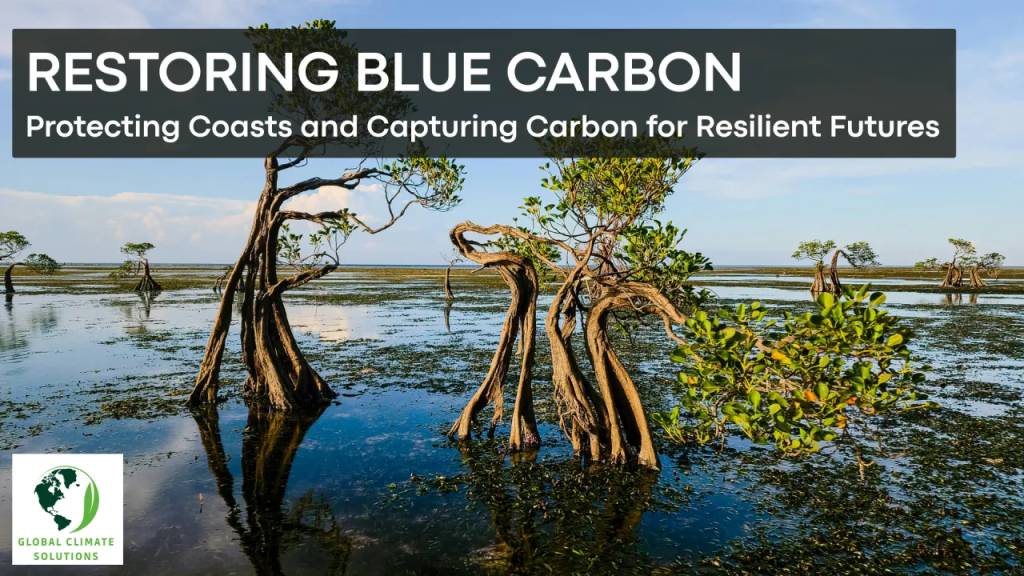
This week, we spotlight how restoring coastal “blue carbon” ecosystems is vital for climate mitigation, biodiversity, and community resilience.
🌊 Blue Carbon Restoration: Nature’s Climate Solution
Coastal ecosystems—mangroves, salt marshes, and seagrass meadows—store vast amounts of carbon, often exceeding tropical forests. Yet human activity and climate change threaten their survival. Protecting and restoring these ecosystems safeguards critical ecological and climate functions.
Restoration involves replanting vegetation, restoring tidal flows, and improving water quality. These efforts enhance carbon sequestration, reduce erosion, support biodiversity, and provide natural defenses against climate impacts such as flooding and sea-level rise.
🌱 Strategies for Effective Blue Carbon Restoration
Success depends on choosing suitable sites, using native species, and involving communities. Local engagement and traditional knowledge strengthen outcomes, while policy frameworks and carbon credit financing help scale restoration globally.
🔆 Case Study: The Blue Heart — Australia’s Blue Carbon Project
Queensland’s Blue Heart initiative is transforming farmland into wetlands, generating carbon credits, boosting biodiversity, and involving First Nations communities. With over $2 million in federal funding, it is Australia’s first registered blue carbon project.
📖 Read More
Read the full article by Robert C. Brears to explore how blue carbon restoration is tackling climate change while supporting communities. Learn how projects like the Blue Heart are shaping resilient coasts.
Key Takeaways
Blue carbon restoration enhances climate resilience, biodiversity, and economic opportunity. Expanding efforts globally is essential to preserve coastal ecosystems and secure a sustainable future.
WATER-FOOD NEXUS Webinar Series: Circularity, Innovation & Sustainability
Join our four-part online webinar series by EIT Food and Our Future Waterto build skills in systems thinking, design innovation, nature-based strategies, and sustainable financing. Learn live, connect globally, and gain practical tools to advance circular, resilient water-food systems — all from anywhere in the world.
PUBLISHED: Circular Economy and Liveable Cities (Cambridge University Press)
The Circular Economy and Liveable Cities, edited by Robert C. Brears, Our Future Water, has been published. This essential guide delivers actionable strategies and best practices for implementing circular economy, climate resilience, and sustainability in urban environments, with global examples from leading cities like Tokyo, New York, and Singapore to help planners, policymakers, and researchers build liveable and sustainable cities for the future.
📘 Coming Soon — 2nd Edition of Nature-Based Solutions to 21st Century Challenges (Routledge)
Fully revised and updated, the second edition of Nature-Based Solutions to 21st Century Challenges by Robert C. Brears offers a timely and systematic review of how working with nature can address today’s most pressing environmental and societal issues. Featuring new case studies from across the globe, expanded insights on public policy, AI, and community-led initiatives, this edition is essential reading for anyone shaping a sustainable future.
📚 New Book Titles on Blue Carbon and Coastal Resilience
📚 Coastal Resilience Through Nature-Based Solutions: Ecosystem restoration, flood protection, and sustainable adaptation.
📚 Marine Protected Areas: Blue carbon storage, emissions reduction, and sustainable coastal livelihoods.
📚 Coastal Resilience and Climate Change: Wetlands, estuarine buffers, flood protection, and sea level rise adaptation.
📚 Shape the Future of Sustainability: Contribute to Springer Nature’s Landmark Publications
As Editor-in-Chief, Robert C. Brears invites experts, researchers, and practitioners to contribute to impactful and forward-thinking publications from Springer Nature. These comprehensive Handbooks and Encyclopedias explore Nature-Based Solutions, sustainable resource management, ecosystem well-being, and the global energy transition.
- Palgrave Handbook of Nature-Based Solutions
- Palgrave Encyclopedia of Sustainable Resources and Ecosystem Resilience
- Palgrave Handbook of Ecosystems and Human Well-Being
- Palgrave Handbook of Energy Transition and Renewable Energy
- Palgrave Handbook of Urban Climate and Disaster Resilience
- Palgrave Handbook of Social Transformations in Science, Innovation, and Education
📚 Shape the Future of Climate Resilience: Contribute to Palgrave’s Pivot Series
As Series Editor, Robert C. Brears invites experts to contribute to Palgrave Studies in Climate Resilient Societies, a leading Pivot series (25,000–50,000 words) exploring climate resilience, policy innovation, and sustainability strategies.
📩 For more details, visit: Seeking Authors — Palgrave Studies in Climate Resilient Societies