City planners and municipal leaders
For public decision-makers coordinating land use, permitting, food policy, infrastructure and accountable urban-agriculture portfolios.

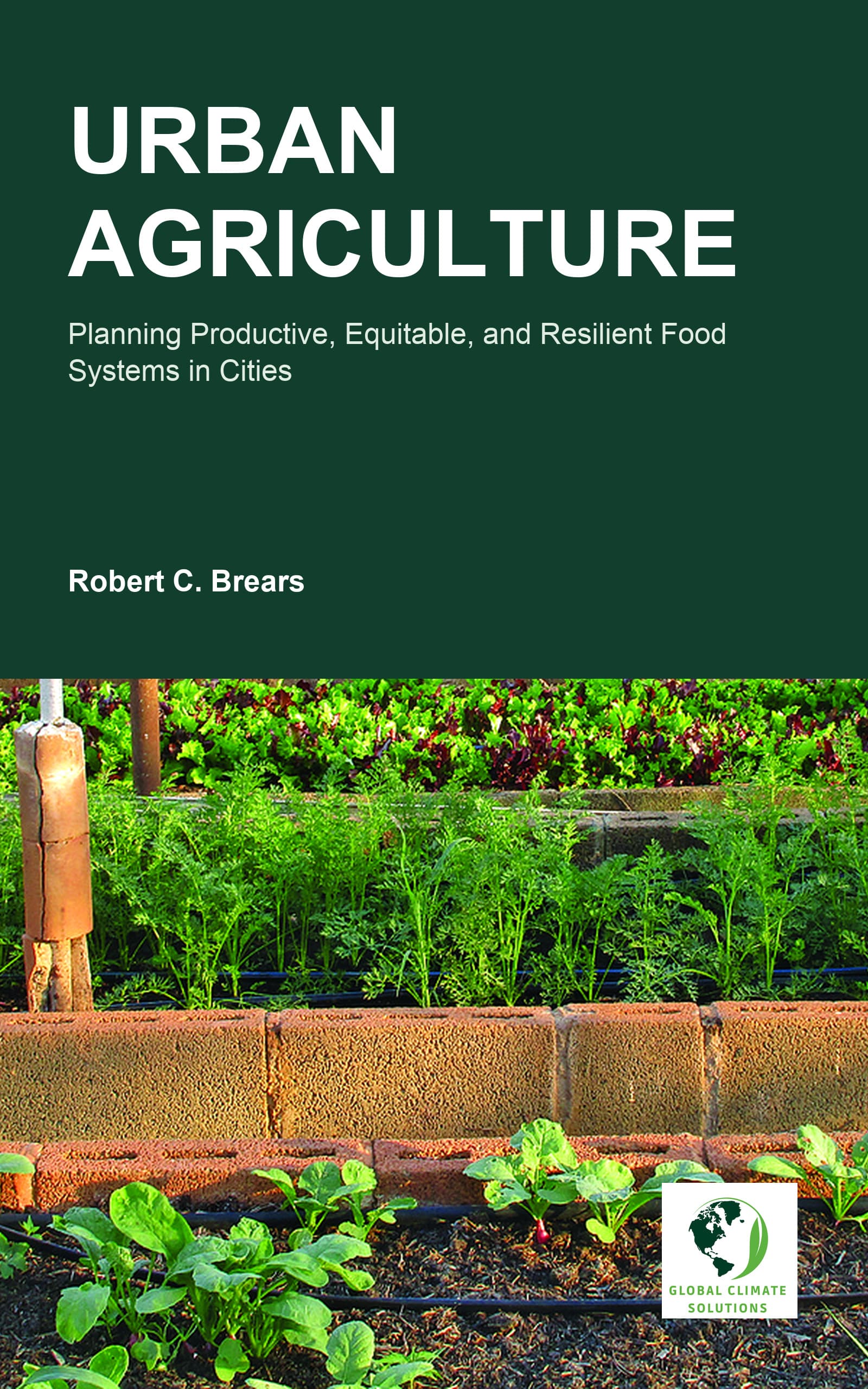
Planning Productive, Equitable, and Resilient Food Systems in Cities
ISBN 978-1-991367-06-8 · Global Climate Solutions · First EditionCities are turning to food production to improve access, resilience, public space, and local enterprise. Yet visible projects can conceal hard questions about land, water, safety, energy, finance, and who benefits.
Written for planners, policymakers, food-system practitioners, researchers, community leaders, and informed readers, this book offers a practical framework for choosing and governing urban growing systems. It connects soil-based gardens, rooftops, controlled environments, resource loops, markets, institutions, and investment to the conditions that shape real performance.
Robert C. Brears shows how to compare production models, assess trade-offs, protect health, structure partnerships, and measure outcomes without overstating what local cultivation can deliver. Evidence from cities and research worldwide grounds the analysis in implementation.
Readers gain a disciplined way to design portfolios of projects that fit local needs, manage risk, and strengthen urban food systems over time.
Define urban agriculture as a city-system capability and distinguish its public value, limits and opportunity costs.
Evaluate land, tenure, zoning, safety and urban-design conditions before selecting sites or production models.
Compare soil-based, rooftop, building-integrated and controlled-environment systems using operational performance evidence.
Assess water, nutrients, energy and organic-waste loops while applying health, environmental and resource safeguards.
Design food-access, aggregation, procurement and market arrangements that connect production to reliable local value chains.
Build governance, finance, equity, monitoring and implementation portfolios that fit local capacity and manage risk over time.
Urban Agriculture as a City-System Question
Defining Urban Agriculture and Its Public Value
Land, Space, and Urban Form
Production Models, Technology, and Operational Performance
Water, Nutrients, Energy, and Circular Resource Systems
Food Access, Markets, and Local Value Chains
Governance, Institutions, and Regulation
Finance, Investment, and Economic Viability
Equity, Inclusion, and Community Capability
Planning the Next Generation of Urban Agriculture
Urban Agriculture as a Governed Urban Capability
For public decision-makers coordinating land use, permitting, food policy, infrastructure and accountable urban-agriculture portfolios.
For professionals linking production choices to access, nutrition, safety, distribution, procurement and community outcomes.
For practitioners assessing tenure, operating models, partnerships, resource needs and durable stewardship arrangements.
For teams evaluating capital requirements, operating economics, blended finance, non-market value and implementation risk.
For readers seeking an evidence-led framework spanning technology, urban form, circular resources, governance and equity.

Robert C. Brears is the founder and editor-in-chief of Global Climate Solutions. His work connects climate resilience, water security, nature-based solutions, sustainable finance and the transition to more resilient cities and industries.
View author profile →Readers gain a disciplined way to design portfolios of projects that fit local needs, manage risk, and strengthen urban food systems over time.

Biodiversity conservation protects the ecological functions that underpin climate resilience, while accountable restoration finance turns policy commitments into measurable recovery.
Agricultural systems face growing drought, heat, water, and production risks that can weaken climate resilience and long-term sustainability.
Transport systems remain major sources of greenhouse gas emissions, while limited charging access can constrain vehicle electrification.