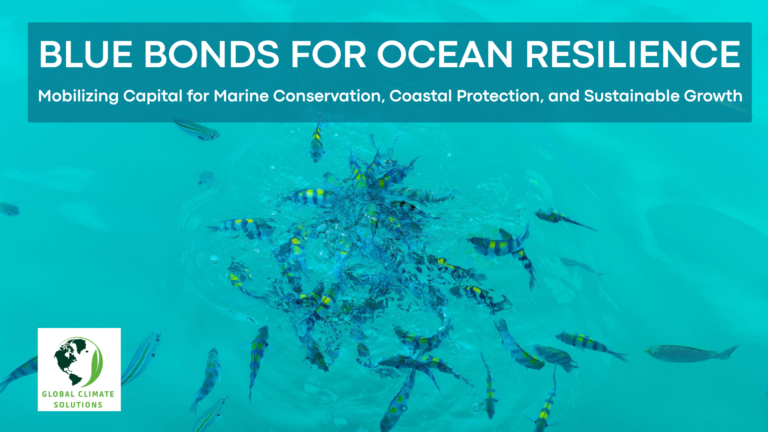
As rising sea levels and coastal degradation intensify, countries are exploring new ways to fund ocean conservation and climate resilience. Blue bonds — innovative financial instruments tied to the sustainable management of marine and coastal ecosystems — are transforming how nations mobilize resources for their blue economies. Explore how the Seychelles’ Sovereign Blue Bond strengthens coastal resilience by aligning sustainable finance with global climate and biodiversity goals.
Financing the Blue Economy
Blue bonds are designed to finance projects that protect ocean ecosystems while fostering economic growth in coastal regions. They channel capital toward sustainable fisheries, marine protected areas, and resilient coastal infrastructure. By linking investor returns to environmental outcomes, blue bonds bridge the gap between global finance and local action.
Governments and development banks use these instruments to attract private capital to public-good investments — projects that typically struggle to secure commercial funding. The bond structure provides accountability through transparent reporting and performance metrics aligned with international sustainability frameworks, ensuring funds are directed toward measurable impact.
Linking Conservation and Economic Opportunity
Blue bonds demonstrate that ocean protection and economic growth can coexist. Funds raised support community-led fisheries, eco-tourism, and ocean restoration programs that generate income while preserving ecosystems. This dual benefit — economic opportunity alongside environmental stewardship — makes blue bonds a powerful tool for sustainable development.
By embedding sustainability into capital markets, blue bonds encourage investors to align long-term financial returns with planetary health. They represent a growing segment of the sustainable finance market, complementing green bonds but with a targeted focus on the world’s oceans — our planet’s most critical carbon sink and biodiversity reservoir.
Building Investor Confidence through Partnerships
Effective blue bond issuance depends on robust governance, international cooperation, and blended finance. Development institutions such as the World Bank, regional development banks, and global environment funds often provide technical support, guarantees, or concessional loans to lower risk and attract private investors.
These partnerships establish credibility, ensure compliance with recognized standards, and enable small island developing states (SIDS) and coastal nations to access global capital markets. By integrating environmental, social, and governance (ESG) principles, blue bonds contribute to stronger financial ecosystems that value long-term resilience over short-term gain.
How Seychelles’ Sovereign Blue Bond Strengthens Coastal Resilience
In 2018, the Republic of Seychelles launched the world’s first sovereign blue bond, raising US$15 million from international investors to support sustainable marine and fisheries management. Developed with assistance from the World Bank and the Global Environment Facility (GEF), the bond set a global precedent for financing the sustainable blue economy.
The blue bond was structured with a US$5 million World Bank guarantee and a US$5 million concessional loan from the GEF to lower borrowing costs. Its proceeds are managed through two national mechanisms: the Blue Grants Fund, administered by the Seychelles Conservation and Climate Adaptation Trust (SeyCCAT), and the Blue Investment Fund, overseen by the Development Bank of Seychelles (DBS).
Funds support initiatives to expand marine protected areas, improve fisheries governance, and promote sustainable livelihoods. This structure combines public and private investment to empower communities, build capacity, and safeguard marine biodiversity. Investors — including Calvert Impact Capital, Nuveen, and Prudential Financial — recognized the bond’s potential to blend financial returns with environmental and social impact.
Conclusion: Blue Bonds as Catalysts for Ocean Resilience
Blue bonds are reshaping sustainable finance by connecting global investors with ocean conservation. They fund coastal resilience, restore marine ecosystems, and support inclusive economic growth — anchoring finance in the stewardship of our planet’s blue capital.
Newly Published: Circular Economy and Liveable Cities (Cambridge University Press)
The Circular Economy and Liveable Cities, edited by Robert C. Brears, Our Future Water, has been published. This essential guide delivers actionable strategies and best practices for implementing circular economy, climate resilience, and sustainability in urban environments, with global examples from leading cities like Tokyo, New York, and Singapore to help planners, policymakers, and researchers build liveable and sustainable cities for the future.
📘 Coming Soon — 2nd Edition of Nature-Based Solutions to 21st Century Challenges (Routledge)
Fully revised and updated, the second edition of Nature-Based Solutions to 21st Century Challenges by Robert C. Brears offers a timely and systematic review of how working with nature can address today’s most pressing environmental and societal issues. Featuring new case studies from across the globe, expanded insights on public policy, AI, and community-led initiatives, this edition is essential reading for anyone shaping a sustainable future.
📚 Explore the Full Book Collection on Nature-Based Solutions (NBS)
Harness the power of nature to tackle today’s climate and development challenges. Curated by Our Future Water and Global Climate Solutions, this collection offers practical frameworks for embedding NBS into policy, planning, and implementation.
🌱 Strategies for integrating NBS into planning, finance, and ecosystem restoration
🌍 Approaches that enhance biodiversity, climate adaptation, and resilience
📘 Tools for applying NBS across sectors and governance systems
Click here to explore the complete collection.
📚 Shape the Future of Sustainability: Contribute to Springer Nature’s Landmark Publications
As Editor-in-Chief, Robert C. Brears invites experts, researchers, and practitioners to contribute to impactful and forward-thinking publications from Springer Nature. These comprehensive Handbooks and Encyclopedias explore Nature-Based Solutions, sustainable resource management, ecosystem well-being, and the global energy transition.
- Palgrave Handbook of Nature-Based Solutions
- Palgrave Encyclopedia of Sustainable Resources and Ecosystem Resilience
- Palgrave Handbook of Ecosystems and Human Well-Being
- Palgrave Handbook of Energy Transition and Renewable Energy
- Palgrave Handbook of Urban Climate and Disaster Resilience
- Palgrave Handbook of Social Transformations in Science, Innovation, and Education
📚 Shape the Future of Climate Resilience: Contribute to Palgrave’s Pivot Series
As Series Editor, Robert C. Brears invites experts to contribute to Palgrave Studies in Climate Resilient Societies, a leading Pivot series (25,000–50,000 words) exploring climate resilience, policy innovation, and sustainability strategies.
📩 For more details, visit: Seeking Authors — Palgrave Studies in Climate Resilient Societies