
Rising urban temperatures threaten public health, infrastructure performance, and economic productivity in dense metropolitan regions. Cities must integrate climate-responsive planning and technological tools to sustain liveability under escalating heat stress. This challenge holds global policy significance as urban populations expand and climate risks intensify. Examine how Singapore’s climate-sensitive urban design framework advances integrated heat mitigation for global climate action.
Integrated Urban Cooling Mechanisms
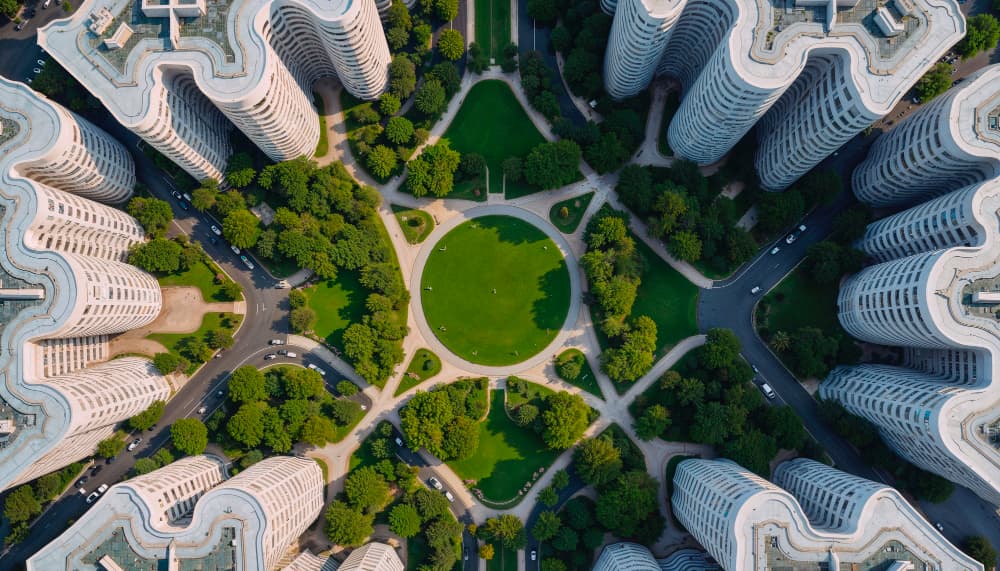
Urban climate cooling systems combine spatial planning, landscape design, and material performance to moderate ambient temperatures. Green infrastructure reduces surface heat absorption while enhancing evapotranspiration and shading. Building morphology influences wind permeability and solar exposure, shaping microclimate outcomes at district scales. These mechanisms operate collectively to reduce heat accumulation and improve outdoor comfort. Effective integration requires coordination between land-use policy, design standards, and environmental modelling.
Urban Ventilation and Wind Corridor Planning
Urban ventilation strategies manage airflow pathways to dissipate heat trapped within dense built environments. Planning authorities often mandate spacing ratios, height transitions, and porosity requirements to preserve natural wind movement. Wind corridor protection ensures that large developments do not obstruct prevailing airflow patterns. Simulation tools assess the impact of urban form on thermal comfort and guide iterative design adjustments. These approaches enhance resilience by reducing reliance on energy-intensive cooling technologies.
Surface Reflectivity and Thermal Material Innovation
Thermally reflective materials contribute to urban cooling by lowering solar heat absorption across roofs, façades, and pavements. Cool coatings and high-albedo surfaces reduce surface temperatures and the subsequent re-radiation of heat. Adoption of such materials can deliver measurable reductions in ambient heat within residential districts. Regulatory frameworks and incentive programmes often accelerate deployment through pilot trials and scaling pathways. Integration with broader urban design strategies ensures cumulative cooling benefits.
Digital Modelling and Urban Climate Intelligence
Urban climate cooling systems increasingly rely on computational modelling to predict thermal performance. Digital twins and integrated environmental simulators enable planners to test multiple development scenarios before implementation. High-resolution datasets support analysis of wind flow, solar exposure, and anthropogenic heat emissions. These tools inform policy trade-offs by quantifying comfort improvements and energy implications. Institutional collaboration between research entities and planning agencies strengthens evidence-based decision-making.
Case Study: Singapore Urban Climate Cooling Strategy
Singapore’s urban climate cooling strategy operates through statutory planning guidance, technological experimentation, and cross-agency collaboration. Climate-sensitive design requirements embedded in planning processes guide building spacing, height variation, and preservation of wind corridors. Environmental modelling informs development approvals, ensuring that airflow pathways remain functional as precincts intensify. Developers must incorporate ventilation considerations at both building and district scales to mitigate urban heat island effects.
The Urban Redevelopment Authority uses iterative simulation to refine wind corridors as new developments progress. Environmental sensors deployed within selected estates collect empirical data on airflow and ambient temperature patterns. Wind LiDAR technology measures wind conditions at multiple elevations, improving the accuracy of modelling frameworks used in urban planning. These sensing mechanisms support adaptive design responses by validating predicted thermal outcomes.
Surface-cooling interventions complement ventilation strategies by applying reflective coatings. A pilot initiative under the Green Towns Programme tested cool coatings across approximately 130 residential blocks. Results indicated reductions in surrounding ambient temperatures of up to two degrees Celsius. Following this pilot, authorities committed to scaling deployment across public housing estates to enhance urban thermal comfort.
Digital planning platforms further strengthen system-wide heat management. The Integrated Environmental Modeller supports simulation of wind, solar irradiance, and temperature interactions using three-dimensional urban models. The Digital Urban Climate Twin integrates climate datasets and anthropogenic heat sources to evaluate policy scenarios at an island-wide scale. Together, regulatory guidance, technological monitoring, and material innovation support climate resilience outcomes by embedding cooling performance into urban development practice. These measures align with national adaptation priorities outlined in Singapore’s urban resilience planning framework.
Conclusion
Urban climate cooling systems illustrate how integrated planning, technology, and material innovation can reduce heat risks in dense environments. Systemic adoption of such approaches strengthens climate resilience while supporting broader sustainability and public health objectives.